Trump, President of U.S. v. Hawaii
The Court reversed the Ninth Circuit, ruling that challengers to the presidential travel restriction proclamation were unlikely to succeed on their INA or Establishment Clause claims, and vacated the injunction and remanded.· AI-written
138 S. Ct. 2392 · No. 17-965 · 2017 term · Roberts Court
Decided Jun 26, 2018 · argued Apr 25, 2018
Civil rights · Immigration and naturalization: miscellaneous
Landmark · ForeignOverruled precedent
Majority opinion: John Roberts
The voteMajorityDissent
5–45 in the majority, 4 in dissent
4 dissents (5–4)
Reversed and remanded. Trump, President of U.S. won.
What this ruling means
Reversed and remanded: the Supreme Court overturned the decision of the U.S. Court of Appeals, Ninth Circuit and sent the case back to that court for further proceedings that follow the Supreme Court’s ruling.
Trump, President of U.S. was the petitioner, the side that asked the Supreme Court to review the case. “Won” means the Court gave that side the result it asked for.
From the Supreme Court Database. A justice who agreed with the result but not the reasoning counts in the majority.
Summary
The opening of the case’s Wikipedia article: what the case was about and what the Court held.
Trump v. Hawaii, 585 U.S. 667 (2018), is a landmark decision of the United States Supreme Court involving Presidential Proclamation 9645 signed by President Donald Trump, which restricted travel into the United States by people from several nations, or by refugees without valid travel documents. Hawaii and several other states and groups challenged the Proclamation and two predecessor executive orders also issued by Trump on statutory and constitutional grounds. Citing a variety of statements by Trump and administration officials, they argued that the proclamation and its predecessor orders were motivated by Islamophobic animus.
A U.S. district court issued a preliminary injunction preventing the ban from coming into effect, finding that plaintiffs were likely to succeed in their argument that the proclamation violated the Establishment Clause of the First Amendment to the United States Constitution and exceeded the president's powers under the Immigration and Nationality Act (INA). The U.S. Court of Appeals for the Ninth Circuit affirmed this injunction, ruling that the proclamation was likely a violation of INA; the court of appeals did not reach the constitutional issue.
On June 26, 2018, the Supreme Court reversed the Court of Appeals in a 5–4 decision, ruling that plaintiffs did not have "likelihood of success on the merits" on either their INA or their Establishment Clause claims. The court vacated the injunction and remanded the case to lower courts for further proceedings. The decision, written by Chief Justice John Roberts, applied rational basis review and emphasized deference to the executive branch. In addressing the travel ban, the Court also repudiated the infamous decision Korematsu v. United States, 323 U.S. 214 (1944), which had justified the president's powers to establish internment camps for Japanese Americans during World War II.
In dissent, Justice Sonia Sotomayor wrote that the decision "redeploys the same dangerous logic underlying Korematsu and merely replaces one gravely wrong decision with another." Responding to her dissent, Roberts wrote: "Korematsu has nothing to do with this case. The forcible relocation of U.S. citizens to concentration camps, solely and explicitly on the basis of race, is objectively unlawful and outside the scope of Presidential authority."
Data notes
The text is Wikipedia’s (CC BY-SA 4.0), matched to the case by its citation, docket number or name and year, and is not checked against the opinion. The site keeps the article’s opening section, ending on its last full sentence. The one-sentence summary under the title is the Decisions list’s: Wikipedia’s own ruling sentence, or, tagged “AI-written”, one Claude wrote from this opening.
How the justices voted
Each justice who took part, placed by their Martin–Quinn ideology score for the 2017 term. Filled: the 5 in the majority. Hollow: the 4 in dissent. Colour is the party of the president who appointed them.
Majority(5)
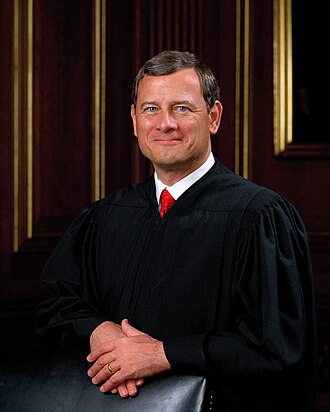 John RobertsWrote the majority opinion
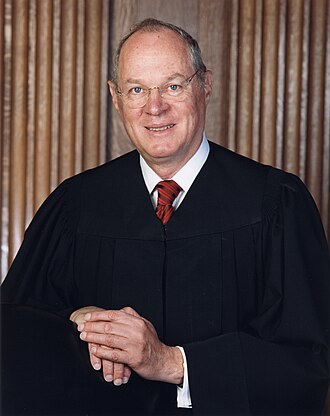 Anthony KennedyWrote a concurrence
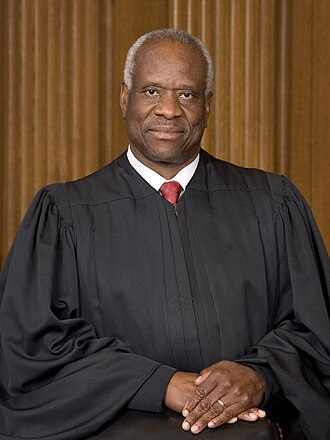 Clarence ThomasWrote a concurrence
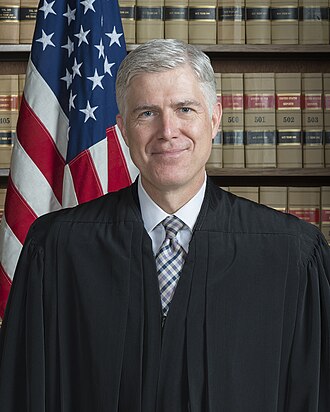 Neil GorsuchJoined the majority
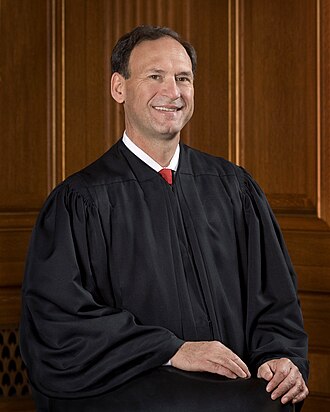 Samuel AlitoJoined the majority
Dissent(4)
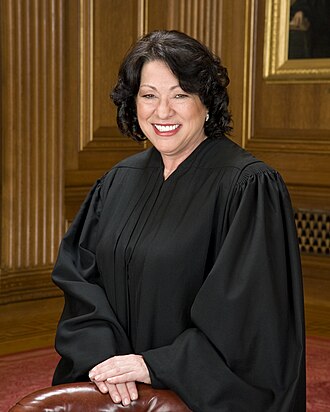 Sonia SotomayorWrote a dissent
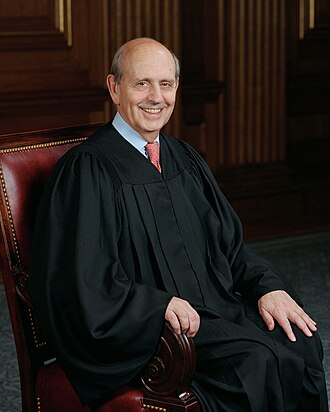 Stephen BreyerWrote a dissent
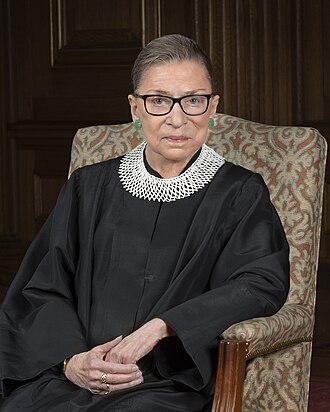 Ruth GinsburgJoined a dissent
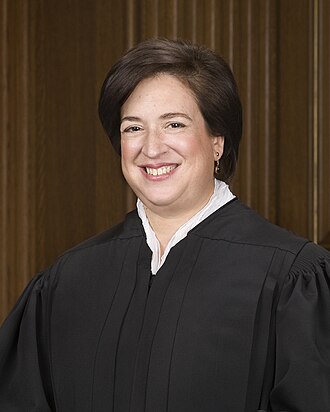 Elena KaganJoined a dissent
Data notes
Each justice’s vote and what they wrote are from the justice-centered file of the Supreme Court Database. “Wrote a concurrence” means the justice sided with the majority and wrote separately; a justice who dissented in part is counted on the side they took overall. A justice who wrote nothing is listed as joining their side.
Positions are each justice’s Martin–Quinn score for the case’s term, the same scores as the Ideology page: negative is more liberal, positive more conservative. A score sums up a justice’s votes across the whole term, so it says where they usually sit, not why they voted as they did here. The median line is the Court’s median justice that term.
The parties
Who brought the case to the Court, who answered it, and how it got there.
- Petitioner
- Trump, President of U.S.Governmental official, or an official of an agency established under an interstate compact (United States)
- Respondent
- HawaiiState (Hawaii)
- Reached the Court by
- Certiorari (the Court chose to hear it)
Data notes
The names are the two sides of the case’s title. The description under each is the Supreme Court Database’s category for that party, in its own wording. The petitioner is the side that asked the Supreme Court to review the decision below. “Why it was taken” appears only when the majority opinion says lower courts disagreed or were unsure about the question; reasons that would fit any case (“to resolve the question presented”, “an important question”) are left out.
The law at issue
The law the Court was asked to apply, and the kind of power it used to decide.
- Provision
- Immigration and Naturalization, Immigration, Nationality, or Illegal Immigration Reform and Immigrant Responsibility Acts, as amended
- Kind of law
- Federal Statute
- Decided by
- Statutory construction
- Precedent
- The Court overruled one of its own earlier decisions.
Data notes
The Supreme Court Database codes the main constitutional provision, statute or court rule each case turned on, and the basis of the decision: judicial review of a federal or state law, interpreting a statute, supervising the lower courts, and so on. A case can rest on more than one. “Overruled” counts only where the majority opinion says so.
Timeline
What happened at the Court and how the case got there, newest first.
- Jun 26, 2018DecidedDecided · Decided 5–4: reversed and remanded. Trump, President of U.S. won.
- Apr 25, 2018ArguedArgued · Oral argument before the Court.
- Not datedTaken upTaken up · The Supreme Court agreed to hear the case (certiorari).
- Not datedCourt belowCourt below · Decided by the U.S. Court of Appeals, Ninth Circuit: reversed and remanded.
- Not datedBeganBegan · The case began in the Hawaii U.S. District Court.
Data notes
From the Supreme Court Database: the court the case began in, the court whose decision the Supreme Court reviewed and what that court did, how the case came to the Court, and the dates of argument and decision. The database does not date the steps in the lower courts. Court names are the database’s.
Other decisions on the same issue
16 other argued cases since 1946 on immigration and naturalization: miscellaneous, newest first.
- Mullin v. al Otro Lado146 S. Ct. 2079Jun 25, 2026 · 146 S. Ct. 2079Civil rights6–36–3 band
- Urias-Orellana v. Bondi607 U.S. 537Mar 4, 2026 · 607 U.S. 537Civil rights9–0Unanimous band
- Department of State v. Muñoz144 S. Ct. 1812Jun 21, 2024 · 144 S. Ct. 1812Civil rights6–36–3 band
- Wilkinson v. Garland601 U.S. 209Mar 19, 2024 · 601 U.S. 209Civil rights6–36–3 band
- Pugin v. Garland599 U.S. 600Jun 22, 2023 · 599 U.S. 600Civil rights6–36–3 band
- Garland v. Ming Dai141 S. Ct. 1669Jun 1, 2021 · 141 S. Ct. 1669Civil rights9–0Unanimous band
- Niz-Chavez v. Garland, Attorney General141 S. Ct. 1474Apr 29, 2021 · 141 S. Ct. 1474Civil rights6–36–3 band
- Barton v. Barr140 S. Ct. 1442Apr 23, 2020 · 140 S. Ct. 1442Civil rights5–45–4 band
- Jennings v. Rodriguez138 S. Ct. 830Feb 27, 2018 · 138 S. Ct. 830Civil rights5–36–3 band
- Kerry v. Din576 U.S. 86Jun 15, 2015 · 576 U.S. 86Civil rights5–45–4 band
- Ignacio Carlos Flores-Figueroa v. United States556 U.S. 646May 4, 2009 · 556 U.S. 646Civil rights9–0Unanimous band
- Hoffman Plastic Compounds, Inc. v. National Labor Relations Board535 U.S. 137Mar 27, 2002 · 535 U.S. 137Civil rights5–45–4 band
- Ronald W. Reagan, President of the United States, et al. v. James Abourezk et al.484 U.S. 1Oct 19, 1987 · 484 U.S. 1Civil rights3–36–3 band
- Rosenberg, District Director, Immigration and Naturalization Service v. Yee Chien Woo402 U.S. 49Apr 21, 1971 · 402 U.S. 49Civil rights5–45–4 band
- International Longshoremen's and Warehousemen's Union, Local 37, et al. v. Boyd, District Director, Immigration and Naturalization Service347 U.S. 222Mar 8, 1954 · 347 U.S. 222Civil rights7–27–2 band
- Clark, Attorney General, As Successor to the Alien Property Custodian, v. Allen et al.331 U.S. 503Jun 9, 1947 · 331 U.S. 503Civil rights9–0Unanimous band
Data notes
Every other orally argued case with a clear vote, from the 1946 term on, that the Supreme Court Database files under the same issue as this one. The database gives each case one issue from a list of about 270 (abortion, search and seizure of vehicles, the death penalty, and so on), whatever law it turned on.
Official record
Read the argument audio on Oyez and Wikipedia. Case data from the Supreme Court Database, Version 2026 Release 01, through the 2025 term.