Gill v. Whitford
In a challenge to Wisconsin's redistricting plan as a partisan gerrymander, the Court remanded the case to the lower courts, finding that the plaintiffs had not demonstrated standing because they had not shown harm.· AI-written
138 S. Ct. 1916 · No. 16-1161 · 2017 term · Roberts Court
Decided Jun 18, 2018 · argued Oct 3, 2017
Judicial power · Standing to sue: direct injury
Majority opinion: John Roberts
The voteMajority
9–09 in the majority, 0 in dissent
No dissent (9–0)
Vacated and remanded. Gill won.
What this ruling means
Vacated and remanded: the Supreme Court set aside the decision of the Wisconsin Western U.S. District Court, wiping it out without necessarily saying the result was wrong, and sent the case back for that court to decide again under the right legal standard.
Gill was the petitioner, the side that asked the Supreme Court to review the case. “Won” means the Court gave that side the result it asked for.
From the Supreme Court Database. A justice who agreed with the result but not the reasoning counts in the majority.
Summary
The opening of the case’s Wikipedia article: what the case was about and what the Court held.
Gill v. Whitford, 585 U.S. 48 (2018), was a United States Supreme Court case involving the constitutionality of partisan gerrymandering. Other forms of gerrymandering based on racial or ethnic grounds had been deemed unconstitutional, and while the Supreme Court had identified that extreme partisan gerrymandering could also be unconstitutional, the Court had not agreed on how this could be defined, leaving the question to lower courts to decide. That issue was later resolved in Rucho v. Common Cause, in which the Court decided that partisan gerrymanders presented a nonjusticiable political question.
Gill arose following the 2011 redistricting plan for the State of Wisconsin created by Republican legislators to maximize the likelihood that the Republicans would be able to secure additional seats in the State legislature over the next few election cycles. The plan was challenged by Democratic citizens, claiming the redistricting plan caused their votes to be "wasted". The case was filed in 2015, and by 2016, the District Court for the Western District of Wisconsin ruled in favor of the Democrats, based on the evaluation of the efficiency gap measure developed for this case, and ordered Wisconsin to redo its districts by 2017. The State appealed the ruling to the Supreme Court, which heard the case in October 2017.
During the Court's deliberations, it also accepted to hear the merits of another partisan gerrymandering case, Benisek v. Lamone, related to the 2011 redistricting of Maryland's 6th congressional district, for which it heard oral arguments in March 2018. While the majority of political scientists agree that Wisconsin's map was heavily biased, it was expected that the case would center on whether the efficiency gap measures and other metrics provided by political scientists meet the criteria that Justice Anthony Kennedy set forth in his concurring opinion in Vieth v. Jubelirer (2004), a previous Supreme Court case dealing with partisan gerrymandering.
Ruling on June 18, 2018, the Court remanded the case to lower courts, finding that the plaintiffs had not demonstrated standing for the case in demonstration of harm, though the Justices were split on to what degree the plaintiffs must show "concrete and particularized injuries".
Data notes
The text is Wikipedia’s (CC BY-SA 4.0), matched to the case by its citation, docket number or name and year, and is not checked against the opinion. The site keeps the article’s opening section, ending on its last full sentence. The one-sentence summary under the title is the Decisions list’s: Wikipedia’s own ruling sentence, or, tagged “AI-written”, one Claude wrote from this opening.
How the justices voted
Each justice who took part, placed by their Martin–Quinn ideology score for the 2017 term. Filled: the 9 in the majority. Hollow: the 0 in dissent. Colour is the party of the president who appointed them.
Majority(9)
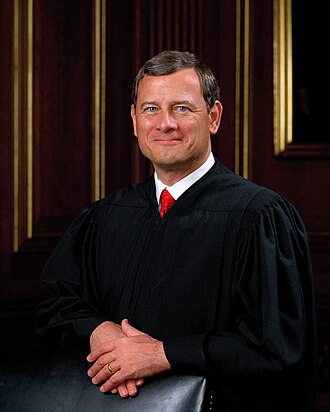 John RobertsWrote the majority opinion
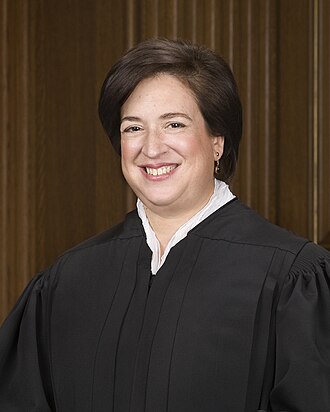 Elena KaganWrote a concurrence
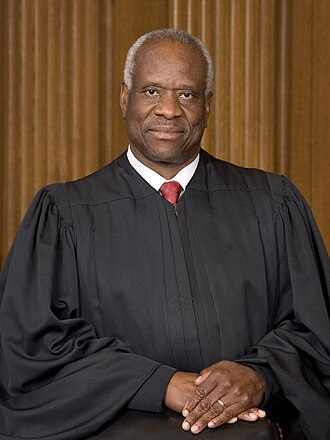 Clarence ThomasWrote a concurrence
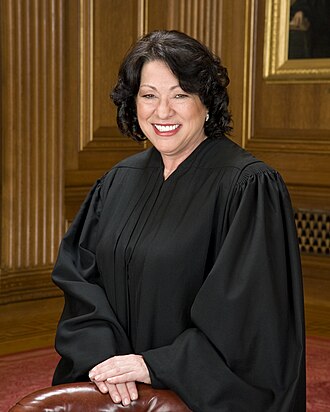 Sonia SotomayorJoined the majority
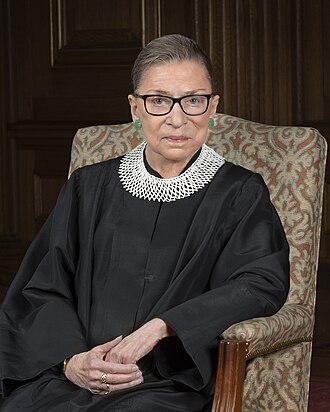 Ruth GinsburgJoined the majority
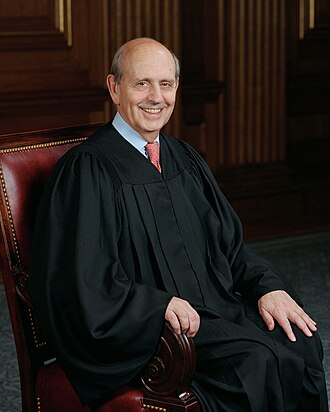 Stephen BreyerJoined the majority
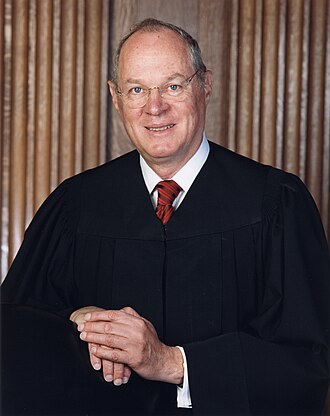 Anthony KennedyJoined the majority
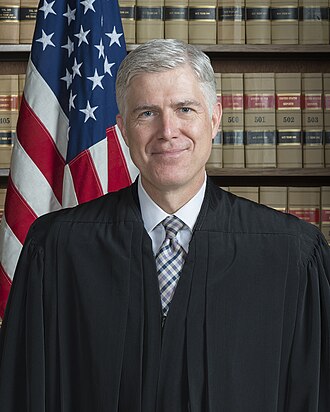 Neil GorsuchJoined the majority
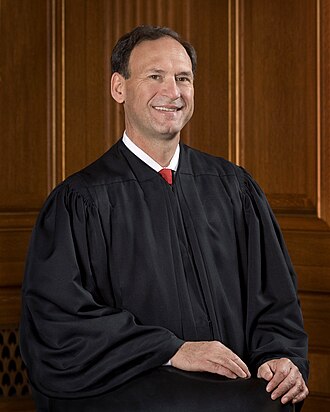 Samuel AlitoJoined the majority
Dissent(0)
- None.
Data notes
Each justice’s vote and what they wrote are from the justice-centered file of the Supreme Court Database. “Wrote a concurrence” means the justice sided with the majority and wrote separately; a justice who dissented in part is counted on the side they took overall. A justice who wrote nothing is listed as joining their side.
Positions are each justice’s Martin–Quinn score for the case’s term, the same scores as the Ideology page: negative is more liberal, positive more conservative. A score sums up a justice’s votes across the whole term, so it says where they usually sit, not why they voted as they did here. The median line is the Court’s median justice that term.
The parties
Who brought the case to the Court, who answered it, and how it got there.
- Petitioner
- GillGovernmental official, or an official of an agency established under an interstate compact (Wisconsin)
- Respondent
- WhitfordVoter, prospective voter, elector, or a nonelective official seeking reapportionment or redistricting of legislative districts (POL)
- Reached the Court by
- Appeal (the Court was required to hear it)
Data notes
The names are the two sides of the case’s title. The description under each is the Supreme Court Database’s category for that party, in its own wording. The petitioner is the side that asked the Supreme Court to review the decision below. “Why it was taken” appears only when the majority opinion says lower courts disagreed or were unsure about the question; reasons that would fit any case (“to resolve the question presented”, “an important question”) are left out.
The law at issue
The law the Court was asked to apply, and the kind of power it used to decide.
- Provision
- Article III, Section 2, Paragraph 1 (case or controversy requirement)
- Kind of law
- Constitution
- Decided by
- Supreme Court supervision of lower federal or state courts or original jurisdiction
Data notes
The Supreme Court Database codes the main constitutional provision, statute or court rule each case turned on, and the basis of the decision: judicial review of a federal or state law, interpreting a statute, supervising the lower courts, and so on. A case can rest on more than one. “Overruled” counts only where the majority opinion says so.
Timeline
What happened at the Court and how the case got there, newest first.
- Jun 18, 2018DecidedDecided · Decided 9–0: vacated and remanded. Gill won.
- Oct 3, 2017ArguedArgued · Oral argument before the Court.
- Not datedTaken upTaken up · Reached the Supreme Court on appeal, which the Court had to hear.
- Not datedCourt belowCourt below · Began in and was decided by the Wisconsin Western U.S. District Court, with a dissent.
Data notes
From the Supreme Court Database: the court the case began in, the court whose decision the Supreme Court reviewed and what that court did, how the case came to the Court, and the dates of argument and decision. The database does not date the steps in the lower courts. Court names are the database’s.
Other decisions on the same issue
13 other argued cases since 1946 on standing to sue: direct injury, newest first.
- First Choice Women’s Resource Centers v. Davenport146 S. Ct. 1114Apr 29, 2026 · 146 S. Ct. 1114Judicial power9–0Unanimous band
- Carney v. Adams141 S. Ct. 493Dec 10, 2020 · 141 S. Ct. 493Judicial power8–0Unanimous band
- Spokeo, Inc. v. Robins578 U.S. 330May 16, 2016 · 578 U.S. 330Judicial power6–27–2 band
- Susan B. Anthony List v. Driehaus573 U.S. 149Jun 16, 2014 · 573 U.S. 149Judicial power9–0Unanimous band
- James R. Clapper, Jr., Director of National Intelligence, et al., Petitioners v. Amnesty International USA et al.568 U.S. 398Feb 26, 2013 · 568 U.S. 398Judicial power5–45–4 band
- Carol Anne Bond, Petitioner v. United StatesLandmark · Federalism564 U.S. 211Jun 16, 2011 · 564 U.S. 211Judicial powerLandmark · Federalism9–0Unanimous band
- Arizona Christian School Tuition Organization, Petitioner v. Kathleen M. Winn et al.563 U.S. 125Apr 4, 2011 · 563 U.S. 125Judicial power5–45–4 band
- Vermont Agency of Natural Resources v. United States, ex rel., Jonathan Stevens529 U.S. 765May 22, 2000 · 529 U.S. 765Judicial power9–0Unanimous band
- Steel Company, aka Chicago Steel and Pickling Company v. Citizens for a Better Environment523 U.S. 83Mar 4, 1998 · 523 U.S. 83Judicial power9–0Unanimous band
- Manuel Lujan, Jr., Secretary of the Interior v. Defenders of Wildlife, et al.Landmark504 U.S. 555Jun 12, 1992 · 504 U.S. 555Judicial powerLandmark6–36–3 band
- Virginia v. American Booksellers Association, Inc., et al.484 U.S. 383Jan 25, 1988 · 484 U.S. 383Judicial power8–0Unanimous band
- Simon, Secretary of the Treasury, et al. v. Eastern Kentucky Welfare Rights Organization et al.426 U.S. 26Jun 1, 1976 · 426 U.S. 26Judicial power8–0Unanimous band
- Warth et al. v. Seldin et al.422 U.S. 490Jun 25, 1975 · 422 U.S. 490Judicial power5–45–4 band
Data notes
Every other orally argued case with a clear vote, from the 1946 term on, that the Supreme Court Database files under the same issue as this one. The database gives each case one issue from a list of about 270 (abortion, search and seizure of vehicles, the death penalty, and so on), whatever law it turned on.
Official record
Read the argument audio on Oyez and Wikipedia. Case data from the Supreme Court Database, Version 2026 Release 01, through the 2025 term.