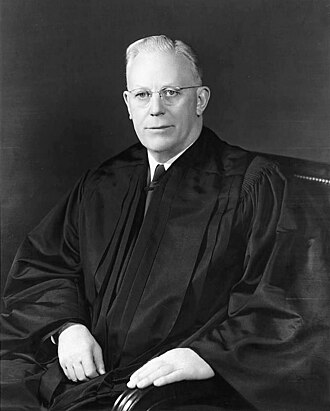
Supreme Court · Chief Justice
Earl Warren
Republican appointee: Appointed by Dwight D. Eisenhower (R)
Served 1953–1969 · 16 terms
Confirmed by voice vote
Biography
Earl Warren was an American attorney and politician who served as the 14th chief justice of the United States from 1953 to 1969 and as the 30th governor of California from 1943 to 1953.
Source: Wikipedia, CC BY-SA 4.0
Ideology over time
Warren and the 16 justices who overlapped with Warren, 1953–1968
- Earl Warren
- 95% credible interval
- Peer, appointed by a Democrat
- Peer, appointed by a Republican
- Court median
How to read this
Martin–Quinn scores place each justice on a single liberal–conservative dimension, estimated from their votes across terms, with scores allowed to shift from one term to the next. Higher is more conservative. The shaded band is the credible interval: wider when the record is thin, especially in a justice’s first terms, and narrower as votes accumulate.
Where Warren sits among all justices
Career average, every justice in the data set
Warren’s range across terms
Served alongside Warren
16 justicesClosest career average first. Filled dot: the peer. Ring: Warren.
How Warren voted
Every argued case Warren took part in, newest first, with how Warren voted in each: with the majority, in dissent, or in an equally divided Court. A Liberal or Conservative tag is the Supreme Court Database’s coding of who prevailed in the case, not a rating of the justices.
Data notes
The Decisions page’s argued cases with this justice’s vote from the Supreme Court Database. “Majority” includes a concurrence; a vote that dissented in part is coded by the side the justice took overall. Cases the justice sat out and equally divided cases are left out of the percentages. “Wrote” means authored an opinion. Source: Supreme Court Database (Spaeth et al.).