John Geddes Lawrence and Tyron Garner v. Texas
The Court ruled that U.S. state laws criminalizing sodomy between consenting adults are unconstitutional.
539 U.S. 558 · No. 02-102 · 2002 term · Rehnquist Court
Decided Jun 26, 2003 · argued Mar 26, 2003
Privacy · Privacy
Landmark · Discrimination based on sexual orientation or gender identityOverruled precedentStruck down a state law
Majority opinion: Anthony Kennedy
The voteMajorityDissent
6–36 in the majority, 3 in dissent
3 dissents (6–3)
Reversed and remanded. John Geddes Lawrence and Tyron Garner won.
What this ruling means
Reversed and remanded: the Supreme Court overturned the decision of the Texas appellate court and sent the case back to that court for further proceedings that follow the Supreme Court’s ruling.
John Geddes Lawrence and Tyron Garner was the petitioner, the side that asked the Supreme Court to review the case. “Won” means the Court gave that side the result it asked for.
From the Supreme Court Database. A justice who agreed with the result but not the reasoning counts in the majority.
Summary
The opening of the case’s Wikipedia article: what the case was about and what the Court held.
Lawrence v. Texas, 539 U.S. 558 (2003), is a landmark decision of the United States Supreme Court in which the Court ruled that U.S. state laws criminalizing sodomy between consenting adults are unconstitutional. The Court reaffirmed the concept of a "right to privacy" that earlier cases had found the United States Constitution provides, even though it is not explicitly enumerated. It based its ruling on the notions of personal autonomy to define one's own relationships and of American traditions of non-interference with any or all forms of private sexual activities between consenting adults.
In 1998, John Geddes Lawrence Jr. was arrested along with Tyron Garner at Lawrence's apartment in Harris County, Texas. Garner's former boyfriend had called the police, claiming that there was a man with a weapon in the apartment. Sheriff's deputies said they found the men engaging in sexual intercourse. Lawrence and Garner were charged with a misdemeanor under Texas' anti-sodomy law; both pleaded no contest and received a fine. Assisted by the American civil rights organization Lambda Legal, Lawrence and Garner appealed their sentences to the Texas Courts of Appeals, which ruled in 2000 that the sodomy law was unconstitutional. Texas appealed to have the court rehear the case en banc, and in 2001 it overturned its prior judgment and upheld the law. Lawrence appealed this decision to the Texas Court of Criminal Appeals, which denied his request for appeal. Lawrence then appealed to the U.S. Supreme Court, which agreed to hear his case.
The Supreme Court struck down the sodomy law in Texas in a 6–3 decision, and by extension invalidated sodomy laws in 13 other states, thus protecting from governmental regulation throughout the U.S. all forms of private, consensual sexual activity between adults. In the same case, the Court overturned its previous ruling in the 1986 case Bowers v. Hardwick, where it had upheld a challenged Georgia statute and did not find a constitutional protection of sexual privacy. It explicitly overruled Bowers, holding that the previous ruling had viewed the liberty interest too narrowly. The Court held that intimate consensual sexual conduct was part of the liberty protected by substantive due process under the Due Process Clause of the Fourteenth Amendment to the U.S. Constitution.
The case attracted much public attention, and 33 amici curiae ("friends of the court") briefs were filed.
Data notes
The text is Wikipedia’s (CC BY-SA 4.0), matched to the case by its citation, docket number or name and year, and is not checked against the opinion. The site keeps the article’s opening section, ending on its last full sentence. The one-sentence summary under the title is the Decisions list’s: Wikipedia’s own ruling sentence, or, tagged “AI-written”, one Claude wrote from this opening.
How the justices voted
Each justice who took part, placed by their Martin–Quinn ideology score for the 2002 term. Filled: the 6 in the majority. Hollow: the 3 in dissent. Colour is the party of the president who appointed them.
Majority(6)
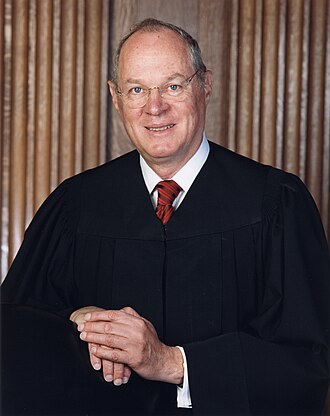 Anthony KennedyWrote the majority opinion
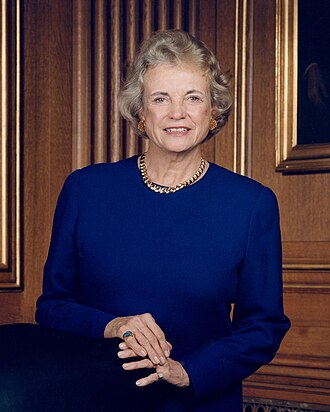 Sandra O'ConnorWrote a concurrence
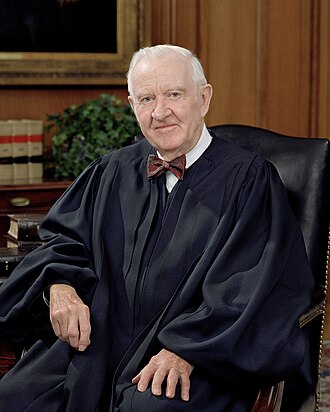 John StevensJoined the majority
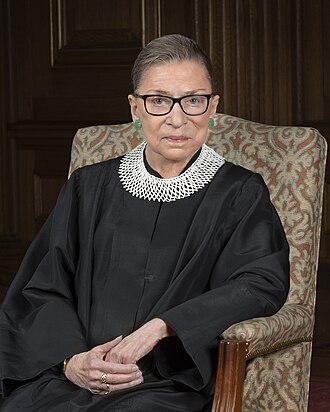 Ruth GinsburgJoined the majority
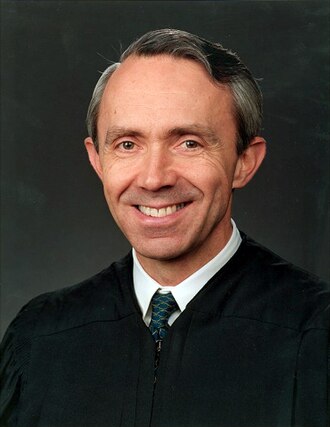 David SouterJoined the majority
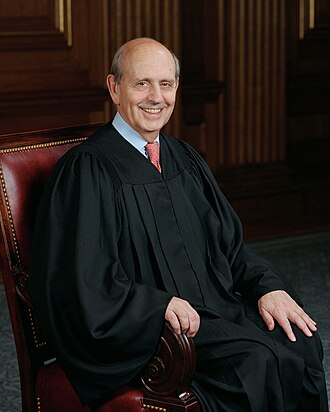 Stephen BreyerJoined the majority
Dissent(3)
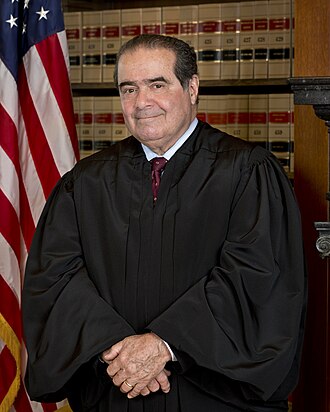 Antonin ScaliaWrote a dissent
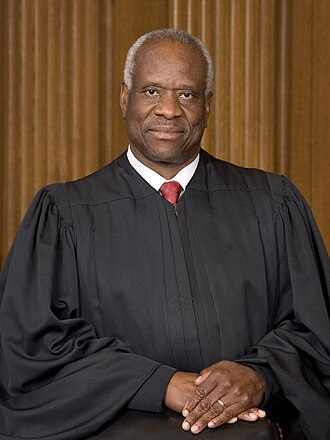 Clarence ThomasWrote a dissent
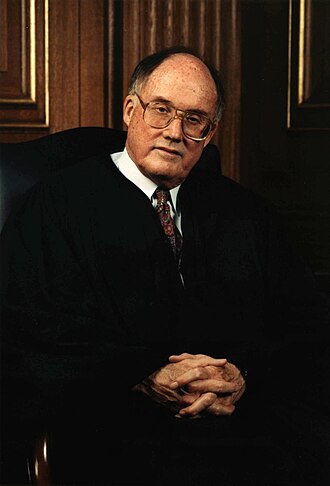 William RehnquistJoined a dissent
Data notes
Each justice’s vote and what they wrote are from the justice-centered file of the Supreme Court Database. “Wrote a concurrence” means the justice sided with the majority and wrote separately; a justice who dissented in part is counted on the side they took overall. A justice who wrote nothing is listed as joining their side.
Positions are each justice’s Martin–Quinn score for the case’s term, the same scores as the Ideology page: negative is more liberal, positive more conservative. A score sums up a justice’s votes across the whole term, so it says where they usually sit, not why they voted as they did here. The median line is the Court’s median justice that term.
The parties
Who brought the case to the Court, who answered it, and how it got there.
- Petitioner
- John Geddes Lawrence and Tyron GarnerLesbian, gay, bisexual, transexual person or organization
- Respondent
- TexasState (Texas)
- Reached the Court by
- Certiorari (the Court chose to hear it)
Data notes
The names are the two sides of the case’s title. The description under each is the Supreme Court Database’s category for that party, in its own wording. The petitioner is the side that asked the Supreme Court to review the decision below. “Why it was taken” appears only when the majority opinion says lower courts disagreed or were unsure about the question; reasons that would fit any case (“to resolve the question presented”, “an important question”) are left out.
The law at issue
The law the Court was asked to apply, and the kind of power it used to decide.
- Provision
- Fourteenth Amendment (due process)
- Kind of law
- Constitutional Amendment
- Decided by
- Judicial review (state level)
- Struck down
- A state law, as unconstitutional
- Precedent
- The Court overruled one of its own earlier decisions.
Data notes
The Supreme Court Database codes the main constitutional provision, statute or court rule each case turned on, and the basis of the decision: judicial review of a federal or state law, interpreting a statute, supervising the lower courts, and so on. A case can rest on more than one. “Overruled” counts only where the majority opinion says so.
Timeline
What happened at the Court and how the case got there, newest first.
- Jun 26, 2003DecidedDecided · Decided 6–3: reversed and remanded. John Geddes Lawrence and Tyron Garner won.
- Mar 26, 2003ArguedArgued · Oral argument before the Court.
- Not datedTaken upTaken up · The Supreme Court agreed to hear the case (certiorari).
- Not datedCourt belowCourt below · Decided by the Texas appellate court: affirmed, with a dissent.
- Not datedBeganBegan · The case began in the Texas trial court.
Data notes
From the Supreme Court Database: the court the case began in, the court whose decision the Supreme Court reviewed and what that court did, how the case came to the Court, and the dates of argument and decision. The database does not date the steps in the lower courts. Court names are the database’s.
Other decisions on the same issue
16 other argued cases since 1946 on privacy, newest first.
- United States, Petitioner v. James X. Bormes568 U.S. 6Nov 13, 2012 · 568 U.S. 6Privacy9–0Unanimous band
- Federal Aviation Administration, et al., Petitioners v. Stanmore Cawthon Cooper566 U.S. 284Mar 28, 2012 · 566 U.S. 284Privacy5–36–3 band
- General Dynamics Corporation, Petitioner, v. United States563 U.S. 478May 23, 2011 · 563 U.S. 478Privacy9–0Unanimous band
- Buck Doe v. Elaine L. Chao, Secretary of Labor540 U.S. 614Feb 24, 2004 · 540 U.S. 614Privacy6–36–3 band
- Board of Education of Independent School District No. 92 of Pottawatomie County, et al. v. Lindsay Earls et al.Landmark · Fourth Amendment rights536 U.S. 822Jun 27, 2002 · 536 U.S. 822PrivacyLandmark · Fourth Amendment rights5–45–4 band
- Gonzaga University and Roberta S. League v. John Doe536 U.S. 273Jun 20, 2002 · 536 U.S. 273Privacy7–27–2 band
- Owasso Independent School District No. I-011, aka Owasso Public Schools, et al. v. Kristja J. Falvo, Parent and Next Friend of Her Minor Children, Elizabeth Pletan, Philip Pletan, and Erica Pletan534 U.S. 426Feb 19, 2002 · 534 U.S. 426Privacy9–0Unanimous band
- Jenifer Troxel, et vir v. Tommie Granville530 U.S. 57Jun 5, 2000 · 530 U.S. 57Privacy6–36–3 band
- Walker L. Chandler, et al. v. Zell D. Miller, Governor of Georgia, et al.520 U.S. 305Apr 15, 1997 · 520 U.S. 305Privacy8–18–1 band
- Roy Romer, Governor of Colorado, et al. v. Richard G. Evans et al.Landmark · Discrimination based on sexual orientation or gender identity517 U.S. 620May 20, 1996 · 517 U.S. 620PrivacyLandmark · Discrimination based on sexual orientation or gender identity6–36–3 band
- Vernonia School District 47j v. Wayne Acton, et ux., etc.Landmark · Fourth Amendment rights515 U.S. 646Jun 26, 1995 · 515 U.S. 646PrivacyLandmark · Fourth Amendment rights6–36–3 band
- Bowers, Attorney General of Georgia v. Hardwick et al.Landmark · Discrimination based on sexual orientation or gender identity478 U.S. 186Jun 30, 1986 · 478 U.S. 186PrivacyLandmark · Discrimination based on sexual orientation or gender identity5–45–4 band
- Nixon v. Warner Communications, Inc., et al.435 U.S. 589Apr 18, 1978 · 435 U.S. 589Privacy5–45–4 band
- Whalen, Commissioner of Health of New York v. Roe et al.429 U.S. 589Feb 22, 1977 · 429 U.S. 589Privacy9–0Unanimous band
- Griswold et al. v. ConnecticutLandmark · Birth control and abortion381 U.S. 479Jun 7, 1965 · 381 U.S. 479PrivacyLandmark · Birth control and abortion7–27–2 band
- Public Utilities Commission of the District of Columbia et al. v. Pollak et al.343 U.S. 451May 26, 1952 · 343 U.S. 451Privacy6–27–2 band
Data notes
Every other orally argued case with a clear vote, from the 1946 term on, that the Supreme Court Database files under the same issue as this one. The database gives each case one issue from a list of about 270 (abortion, search and seizure of vehicles, the death penalty, and so on), whatever law it turned on.
Official record
Read the full opinion on Justia, the argument audio on Oyez and Wikipedia. Case data from the Supreme Court Database, Version 2026 Release 01, through the 2025 term.