Abigail Noel Fisher, Petitioner v. University of Texas at Austin et al.
The Court's ruling in Fisher took Grutter and Bakke as given and did not directly revisit the constitutionality of using race as a factor in college admissions.
570 U.S. 297 · No. 11-345 · 2012 term · Roberts Court
Decided Jun 24, 2013 · argued Oct 10, 2012
Civil rights · Affirmative action
Majority opinion: Anthony Kennedy
The voteMajorityDissent
7–17 in the majority, 1 in dissent
1 dissent (8–1)
Vacated and remanded. Abigail Noel Fisher, Petitioner won.
What this ruling means
Vacated and remanded: the Supreme Court set aside the decision of the U.S. Court of Appeals, Fifth Circuit, wiping it out without necessarily saying the result was wrong, and sent the case back for that court to decide again under the right legal standard.
Abigail Noel Fisher, Petitioner was the petitioner, the side that asked the Supreme Court to review the case. “Won” means the Court gave that side the result it asked for.
From the Supreme Court Database. A justice who agreed with the result but not the reasoning counts in the majority.
Summary
The opening of the case’s Wikipedia article: what the case was about and what the Court held.
Fisher v. University of Texas, 570 U.S. 297 (2013), also known as Fisher I (to distinguish it from the 2016 case), is a United States Supreme Court case concerning the affirmative action admissions policy of the University of Texas at Austin. The Supreme Court voided the lower appellate court's ruling in favor of the university and remanded the case, holding that the lower court had not applied the standard of strict scrutiny, articulated in Grutter v. Bollinger (2003) and Regents of the University of California v. Bakke (1978), to its admissions program. The Court's ruling in Fisher took Grutter and Bakke as given and did not directly revisit the constitutionality of using race as a factor in college admissions.
The suit, brought by undergraduate Abigail Fisher in 2008, asked that the Court declare the university's race-conscious admissions inconsistent with Grutter, which had in 2003 established that race had an appropriate but limited role in the admissions policies of public universities. While reasserting that any consideration of race must be "narrowly tailored", with Fisher the Court did not go on to overrule Grutter, a relief for those who feared that the Court would end affirmative action.
The United States District Court heard Fisher v. University of Texas in 2009 and upheld the legality of the university's admission policy in a summary judgment. The case was appealed to the Fifth Circuit which also ruled in the university's favor. The Supreme Court agreed on February 21, 2012, to hear the case. Justice Elena Kagan recused herself because she served as the Solicitor General when the Department of Justice filed an amicus curiae, or friend-of-the-court, brief in the Fisher case when it was pending in the U.S. Court of Appeals for the Fifth Circuit. On June 24, 2013, the Fifth Circuit's decision was vacated, and the case remanded for further consideration in a 7–1 decision, with Justice Ruth Bader Ginsburg dissenting. Justices Antonin Scalia and Clarence Thomas filed concurring opinions.
Applying the Supreme Court's 2013 decision, the Fifth Circuit once again found for UT Austin in 2014. Fisher again appealed the Fifth Circuit's decision, and in 2016 the Supreme Court upheld the lower court in a 4–3 decision.
Data notes
The text is Wikipedia’s (CC BY-SA 4.0), matched to the case by its citation, docket number or name and year, and is not checked against the opinion. The site keeps the article’s opening section, ending on its last full sentence. The one-sentence summary under the title is the Decisions list’s: Wikipedia’s own ruling sentence, or, tagged “AI-written”, one Claude wrote from this opening.
How the justices voted
Each justice who took part, placed by their Martin–Quinn ideology score for the 2012 term. Filled: the 7 in the majority. Hollow: the 1 in dissent. Colour is the party of the president who appointed them.
Majority(7)
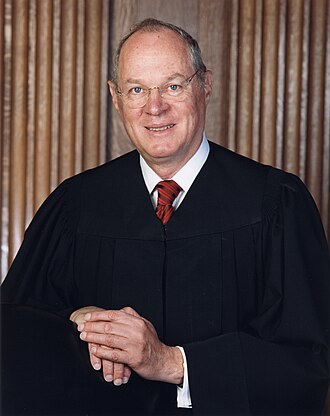 Anthony KennedyWrote the majority opinion
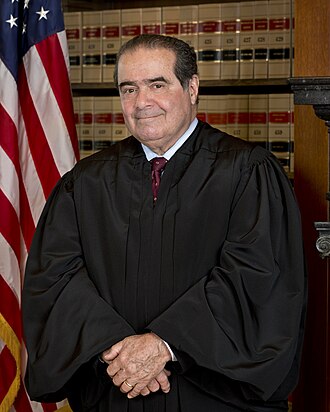 Antonin ScaliaWrote a concurrence
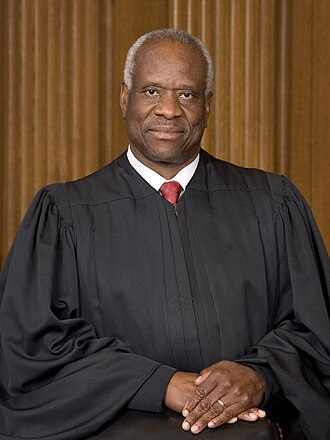 Clarence ThomasWrote a concurrence
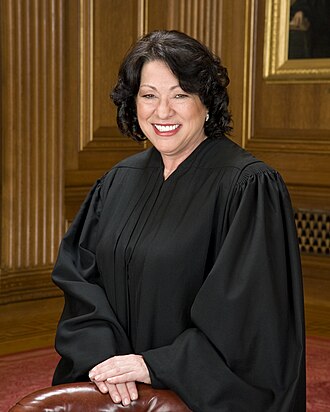 Sonia SotomayorJoined the majority
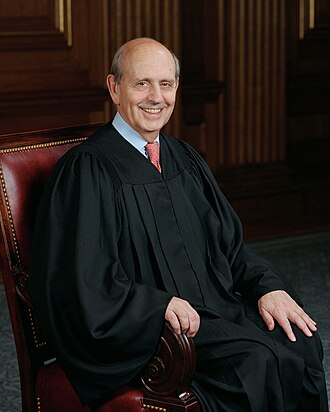 Stephen BreyerJoined the majority
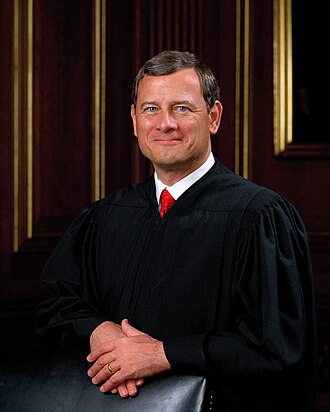 John RobertsJoined the majority
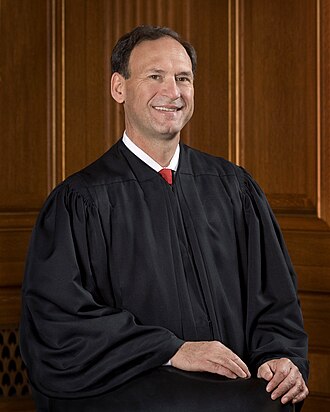 Samuel AlitoJoined the majority
Dissent(1)
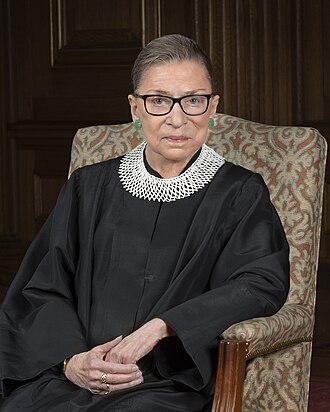 Ruth GinsburgWrote a dissent
Did not take part: Elena Kagan.
Data notes
Each justice’s vote and what they wrote are from the justice-centered file of the Supreme Court Database. “Wrote a concurrence” means the justice sided with the majority and wrote separately; a justice who dissented in part is counted on the side they took overall. A justice who wrote nothing is listed as joining their side.
Positions are each justice’s Martin–Quinn score for the case’s term, the same scores as the Ideology page: negative is more liberal, positive more conservative. A score sums up a justice’s votes across the whole term, so it says where they usually sit, not why they voted as they did here. The median line is the Court’s median justice that term.
The parties
Who brought the case to the Court, who answered it, and how it got there.
- Petitioner
- Abigail Noel Fisher, PetitionerStudent, or applicant for admission to an educational institution
- Respondent
- University of Texas at Austin et al.State college or university (Texas)
- Reached the Court by
- Certiorari (the Court chose to hear it)
Data notes
The names are the two sides of the case’s title. The description under each is the Supreme Court Database’s category for that party, in its own wording. The petitioner is the side that asked the Supreme Court to review the decision below. “Why it was taken” appears only when the majority opinion says lower courts disagreed or were unsure about the question; reasons that would fit any case (“to resolve the question presented”, “an important question”) are left out.
The law at issue
The law the Court was asked to apply, and the kind of power it used to decide.
- Provision
- Fourteenth Amendment (equal protection)
- Kind of law
- Constitutional Amendment
- Decided by
- Judicial review (state level)
Data notes
The Supreme Court Database codes the main constitutional provision, statute or court rule each case turned on, and the basis of the decision: judicial review of a federal or state law, interpreting a statute, supervising the lower courts, and so on. A case can rest on more than one. “Overruled” counts only where the majority opinion says so.
Timeline
What happened at the Court and how the case got there, newest first.
- Jun 24, 2013DecidedDecided · Decided 7–1: vacated and remanded. Abigail Noel Fisher, Petitioner won.
- Oct 10, 2012ArguedArgued · Oral argument before the Court.
- Not datedTaken upTaken up · The Supreme Court agreed to hear the case (certiorari).
- Not datedCourt belowCourt below · Decided by the U.S. Court of Appeals, Fifth Circuit: affirmed, with a dissent.
- Not datedBeganBegan · The case began in the Texas Western U.S. District Court.
Data notes
From the Supreme Court Database: the court the case began in, the court whose decision the Supreme Court reviewed and what that court did, how the case came to the Court, and the dates of argument and decision. The database does not date the steps in the lower courts. Court names are the database’s.
Other decisions on the same issue
24 other argued cases since 1946 on affirmative action, newest first.
- Students for Fair Admissions Inc. v. President & Fellows of Harvard CollegeLandmark · Discrimination based on race and ethnicity600 U.S. 181Jun 29, 2023 · 600 U.S. 181Civil rightsLandmark · Discrimination based on race and ethnicity6–27–2 band
- Fisher v. University of Texas at Austin579 U.S. 365Jun 23, 2016 · 579 U.S. 365Civil rights4–36–3 band
- Schuette v. Coalition to Defend Affirmative ActionLandmark · Discrimination based on race and ethnicity572 U.S. 291Apr 22, 2014 · 572 U.S. 291Civil rightsLandmark · Discrimination based on race and ethnicity6–27–2 band
- Frank Ricci, et al. v. John Destefano et al.557 U.S. 557Jun 29, 2009 · 557 U.S. 557Civil rights5–45–4 band
- Barbara Grutter v. Lee Bollinger et al.Landmark · Discrimination based on race and ethnicity539 U.S. 306Jun 23, 2003 · 539 U.S. 306Civil rightsLandmark · Discrimination based on race and ethnicity5–45–4 band
- Jennifer Gratz and Patrick Hamacher v. Lee Bollinger et al.Landmark · Discrimination based on race and ethnicity539 U.S. 244Jun 23, 2003 · 539 U.S. 244Civil rightsLandmark · Discrimination based on race and ethnicity6–36–3 band
- Adarand Constructors, Inc. v. Federico Pena, Secretary of Transportation, et al.Landmark · Discrimination based on race and ethnicity515 U.S. 200Jun 12, 1995 · 515 U.S. 200Civil rightsLandmark · Discrimination based on race and ethnicity5–45–4 band
- Metro Broadcasting, Inc. v. Federal Communications Commission et al.497 U.S. 547Jun 27, 1990 · 497 U.S. 547Civil rights5–45–4 band
- Martin et al. v. Wilks et al.490 U.S. 755Jun 12, 1989 · 490 U.S. 755Civil rights5–45–4 band
- City of Richmond v. J. A. Croson Company488 U.S. 469Jan 23, 1989 · 488 U.S. 469Civil rights6–36–3 band
- Johnson v. Transportation Agency, Santa Clara County, California, et al.480 U.S. 616Mar 24, 1987 · 480 U.S. 616Civil rights6–36–3 band
- United States v. Paradise et al.480 U.S. 149Feb 25, 1987 · 480 U.S. 149Civil rights5–45–4 band
- Local Number 93, International Association of Firefighters, AFL-CIO, C. L. C. v. City of Cleveland et al.478 U.S. 501Jul 2, 1986 · 478 U.S. 501Civil rights6–36–3 band
- Local 28 of the Sheet Metal Workers' International Association et al. v. Equal Employment Opportunity Commission et al.478 U.S. 421Jul 2, 1986 · 478 U.S. 421Civil rights5–45–4 band
- Wygant et al. v. Jackson Board of Education et al.476 U.S. 267May 19, 1986 · 476 U.S. 267Civil rights5–45–4 band
- Firefighters Local Union No. 1784 v. Stotts et al.467 U.S. 561Jun 12, 1984 · 467 U.S. 561Civil rights6–36–3 band
- Weinberger, Secretary of Defense, et al. v. Rossi et al.456 U.S. 25Mar 31, 1982 · 456 U.S. 25Civil rights9–0Unanimous band
- Minnick et al. v. California Department of Corrections et al.452 U.S. 105Jun 1, 1981 · 452 U.S. 105Civil rights8–18–1 band
- Fullilove et al. v. Klutznick, Secretary of Commerce, et al.448 U.S. 448Jul 2, 1980 · 448 U.S. 448Civil rights6–36–3 band
- United Steelworkers of America, AFL-CIO-CLC v. Weber et al.443 U.S. 193Jun 27, 1979 · 443 U.S. 193Civil rights5–27–2 band
- Southeastern Community College v. Davis442 U.S. 397Jun 11, 1979 · 442 U.S. 397Civil rights9–0Unanimous band
- Regents of the University of California v. BakkeLandmark · Discrimination based on race and ethnicity438 U.S. 265Jun 26, 1978 · 438 U.S. 265Civil rightsLandmark · Discrimination based on race and ethnicity5–45–4 band
- Morton, Secretary of the Interior, et al. v. Mancari et al.417 U.S. 535Jun 17, 1974 · 417 U.S. 535Civil rights9–0Unanimous band
- Defunis et al. v. Odegaard et al.416 U.S. 312Apr 23, 1974 · 416 U.S. 312Civil rights5–45–4 band
Data notes
Every other orally argued case with a clear vote, from the 1946 term on, that the Supreme Court Database files under the same issue as this one. The database gives each case one issue from a list of about 270 (abortion, search and seizure of vehicles, the death penalty, and so on), whatever law it turned on.
Official record
Read the full opinion on Justia, the argument audio on Oyez and Wikipedia. Case data from the Supreme Court Database, Version 2026 Release 01, through the 2025 term.